A value-of-information perspective on exploration and appraisal decisions
In subsurface exploration and appraisal, acquiring more data is often associated with progress. However, new data is costly, and its bottom-line contribution uncertain. Seismic surveys, well tests, and sampling campaigns need to polarize the few, but critical project uncertainties. Data acquisition should be treated as an investment decision, one that must compete for capital based on its ability to improve project value, reduce downside risk, and accelerate confident decision-making.
Getech has spent decades supporting operators across oil & gas and mining in making exactly these data investment trade‑offs. The consistent pattern is that successful projects are not defined by how much new data they acquire, but by how well they frame decisions and how fully they exploit existing geological and geophysical information before committing to more. Rigorous decision framing and the complete use of what is already available outperforms indiscriminate spend on new data.
A practical view on the VOI framework
The value of information (VOI) framework, established in decision analysis (McNamee, 2008), answers a simple question: “Is it worth delaying a decision to acquire more data?”. It compares:
- The value of acting now, based on current knowledge
- The value of acting after acquiring additional data
The difference, net of data cost, defines the value of that new information. Decision trees are typically used to make these trade-offs explicit.
A robust VOI analysis requires careful consideration of several factors that materially influence whether additional data can create value.
First, data is inherently imperfect. New information shifts probabilities rather than resolving uncertainty. Seismic may clarify structure but not connectivity; well tests may confirm rates but not ultimate recovery. The value of data therefore depends on the range of plausible outcomes it may produce, and not a single expected interpretation.
Second, not all uncertainty will be captured in the model. Decision frameworks are limited to explicitly defined risks, leaving “unknown unknowns” that may still affect outcomes. While these cannot be quantified directly, they can be addressed by stress-testing assumptions and favouring decisions that remain robust across a wider set of scenarios.
Third, improved data does not replace disciplined decision-making. Advances in AI and machine learning enhance imaging, interpretation, and integration across datasets. However, these technologies improve inputs but do not change the underlying principle: data only has value if it can influence what you do next.
Finally, the reinterpretation or integration of existing data may show a higher VOI then new acquisition. Companies routinely under-harvest what they already own. Reprocessing vintage seismic with modern algorithms, integrating petrophysics with production history, reconciling core with logs, reinterpreting regional gravity and magnetics, can shift probabilities at very modest costs.
Taken together, these considerations reinforce that VOI is not about eliminating uncertainty, but about applying a disciplined approach to decision-making, thereby ensuring that choices remain robust to both known risks and what cannot be specified.
A disciplined approach to data investment decisions
The six elements of decision quality (Spetzler et al., 2016) provide a useful structure for ensuring a VOI exercise is robust. The first and most critical step is framing the decision. In the context of VOI, this goes beyond simply stating the decision to be made. It requires explicitly defining how new data could change the decision, by identifying the decision trigger: what outcomes or interpretations would lead to proceeding, modifying the plan, or stopping altogether. Equally important is defining the default action if no new data is acquired. The objective is to make clear upfront the conditions under which information has the potential to create value.
This should be followed by defining real alternatives, including proceeding now, delaying for data, or stopping altogether. Without clear framing and credible alternatives, VOI has the risk to degenerate into a justification exercise for new data, rather than a decision tool.
The remaining four elements ensure discipline and impact. Reliable information means explicitly modelling uncertainty in what the new data might reveal. Value and preferences must be stated in economic terms so that attention is focused on uncertainties that truly move project value. Sound reasoning, typically through a decision tree, is then used to compare expected value with and without the new information. Finally, commitment to action is critical: teams must agree upfront how different data outcomes will trigger different decisions.
In practice, most VOI failures can be traced back to poor framing or a lack of commitment to act on the results. VOI exercises that address all six decision criteria create clarity and value; those that do not tend to generate more data, but better decisions rarely follow.
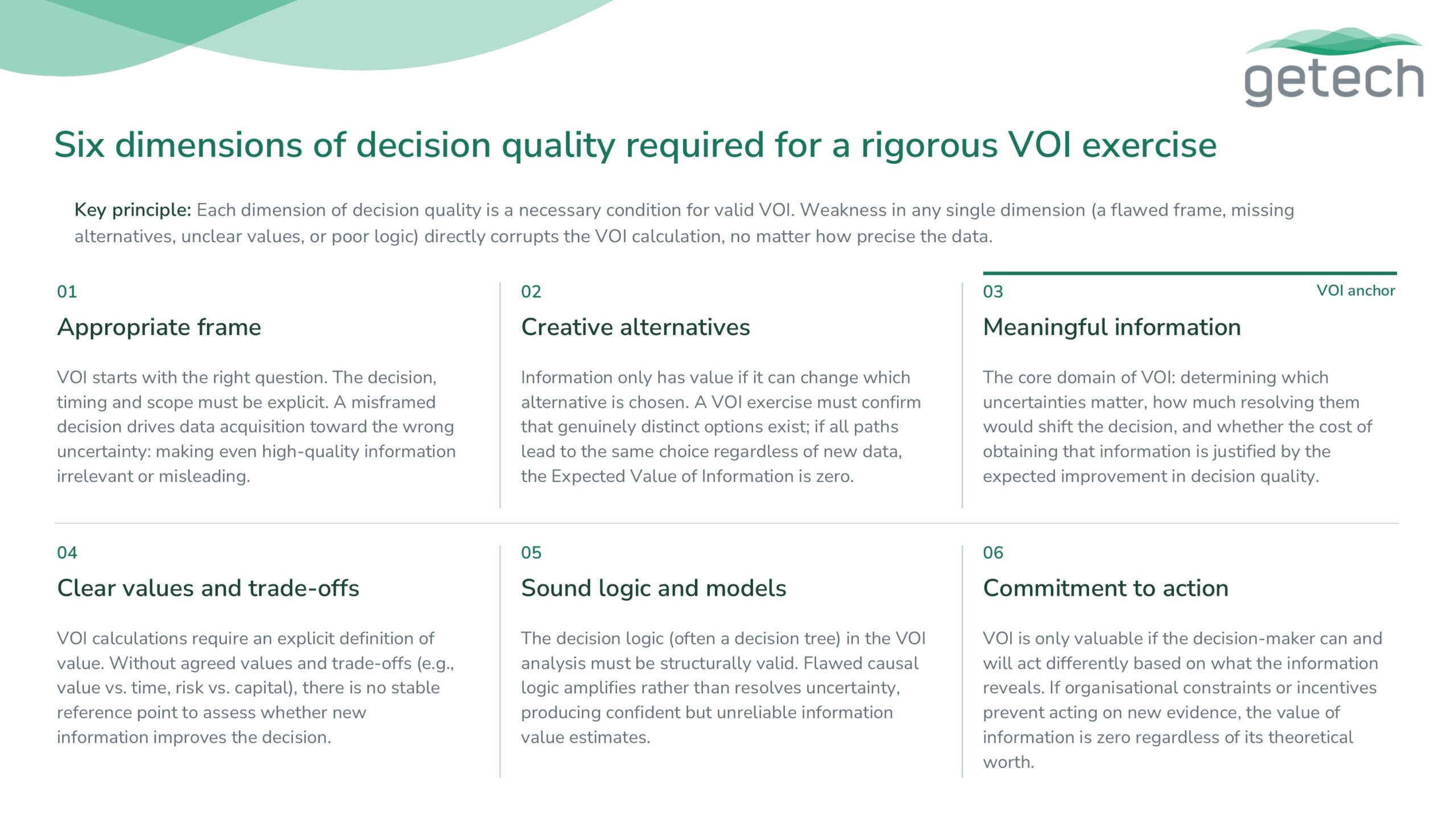
Figure 1: shows the Six Dimensions of Decision Quality required for a rigorous Value‑of‑Information (VOI) exercise, illustrating the conditions that must be satisfied to ensure that data acquisition decisions are objective, decision‑focused, and capable of increasing expected project value.
VOI Across the Exploration – Appraisal Journey
VOI thinking is not a niche technique reserved for frontier prospects; it is relevant at almost every stage of the resource lifecycle, from early regional screening through to late appraisal. As projects mature, the questions change, but the discipline remains the same: does acquiring this data, at this time, increase expected project value once cost and imperfect insight are considered? Applying VOI consistently helps teams avoid both under‑investing in critical insight early and over‑investing in confirmatory data later.
The table below illustrates where VOI exercises are most powerful as projects move from regional exploration into appraisal, across both oil & gas and mining. In each case, the data types differ, but the principle is identical: data only has value if it targets a decision‑critical uncertainty and can credibly change what you do next.
| Project phase | Oil & Gas Typical VOI use cases |
Mining & Minerals
Typical VOI use cases |
| Regional exploration / basin entry | Basin context and chance of success: regional gravity & magnetics, geochemical oil–source correlation, reconnaissance 2D seismic | Regional footprint and targeting: magnetics and gravity, regional IP/resistivity, stream sediment and soil sampling |
| Prospect definition | Structure, trap, and charge risk: focused 2D/3D seismic, FTG, CSEM |
Geometry and scale: high‑resolution geophysics, soil and rock‑chip sampling, early RC drilling |
| Discovery and appraisal | Connectivity and flow uncertainty: appraisal wells, pressure data, cores and SCAL, interference tests, extended well tests | Grade continuity and geometry: RC and diamond drilling, oriented core, downhole EM |
| Late appraisal / pre‑development | Development‑critical uncertainty: 4D seismic, long‑term production testing, pressure monitoring |
Recovery and economics: bulk sampling, metallurgical tests, geostatistical infill drilling |
Table 1: shows where Value‑of‑Information (VOI) analysis is most relevant across the progression from regional exploration to late appraisal, for both Oil & Gas and Mining projects, and highlights typical data acquisition options used to resolve decision‑critical uncertainties at each stage. Abbreviations: 2D/3D/4D seismic = two‑, three‑, and four‑dimensional seismic surveys; FTG = Full‑Tensor Gravity Gradiometry; CSEM = Controlled‑Source Electromagnetics; SCAL = Special Core Analysis; RC = Reverse Circulation drilling; IP = Induced Polarization; EM = Electromagnetics.
VOI in practice
Consider two appraisal decisions that look similar on paper but are not. In the first, a development remains commercial across almost the full range of plausible subsurface interpretations — even a pessimistic reading of connectivity or recovery still clears the investment hurdle. Here, an additional well or survey may sharpen the picture, but it is unlikely to change what the company does next; the VOI is low, however uncertain the geology still feels. In the second case, the same type of project sits close to its economic threshold, and the outcome genuinely hinges on one specific unknown (such as trap integrity, grade continuity, or fluid contacts, for example). Here, data aimed precisely at that uncertainty can determine whether the project proceeds or stops, and the VOI is high. The framework’s value is in telling these two situations apart before capital is committed, not after.
The uncomfortable truth
Often datasets are acquired without a clear, quantified link to a decision, resulting in capital being deployed without a measurable impact on project value. The VOI framework does not eliminate uncertainty, it ensures investment in new information only when it matters. The strongest exploration and appraisal teams treat data acquisition as a strategic investment decision. They spend time up front aligning geology, economics, and decision logic. Because structured thinking is cheap, and mistakes are not.
In short, VOI is not a case for acquiring more data, nor a case against it. It is a discipline for finding out which one is true before spending the budget. That discipline rests on three things: frame the decision before framing the survey, be explicit about what the data can and cannot resolve, and check honestly whether the answer is already sitting in data the company already owns. Applied consistently, this turns data acquisition from a reflex into an investment decision, and it often turns “we need more data” into “we need to use what we have better”.
Independent advice is critical because technology providers are naturally biased toward action, while operators often face internal pressures to “advance” a project. This makes an agnostic third party essential to ensure data acquisition decisions are objective, value‑driven, and not simply the path of least resistance.
Written by Max Brouwers
Talk to Getech
Getech supports operators across all types of subsurface resources in making disciplined, value focussed data acquisition decisions
Our role is to help clients:
- Rapidly frame decisions and define credible alternatives
- Identify the uncertainties that truly drive project value
- Assess whether new data (or better use of existing data, e.g. through application of machine learning) will improve outcomes
- Design focused, cost-effective acquisition or analysis programmes
Because we operate independently of data acquisition, our recommendations are based solely on whether an activity is likely to improve the decision.
Whether evaluating a new survey, designing an appraisal programme, or extracting more from existing data, the objective remains the same: ensure that every data investment is justified by its ability to improve a real decision, not simply to reduce uncertainty.
Get in touch: info@getech.com
References:
- McNamee, P., & Celona, J. (2008). Decision Analysis for the Professional (4th ed.). SmartOrg, Inc.
- Spetzler, C., Winter, H., & Meyer, J. (2016). Decision Quality: Value Creation from Better Business Decisions. Wiley.